...when systems don’t do what they’re supposed to:
The system is straying from its intended path
Priorities become blurred, decisions clash.
Handover processes are stalled
Friction between departments; tasks are left undone.
Capacities shift
Overload creates underload — and vice versa.
Executive Summary
MOAT reduces complex spaces to a single point. — That is where the leverage lies.
MOAT is a set of deductive methods for analysing and managing complex situations in a professional context.
You specify the objective, problem or scope — the method follows logically from the task.
Result: precise queries, a clear structure, well-founded decisions.
MOAT works in any environment.
MOAT is NOT a consultancy format.
MOAT does not hold meetings.
MOAT operates above the system. — LEAN is both within and alongside it.
MOAT identifies causes. — KPIs assess symptoms.
We’ve all been there …
‘Monday cars’, which are full of faults
Cities whose regeneration efforts are entering their fourth phase
Major projects where time and costs are spiralling out of control
Work–life balance versus machine depreciation
Investments & innovations that aren’t taking hold
Career bait and job merry-go-rounds, versus day-to-day business
Events that nobody wants
Dependencies that interfere with the structure
Costs that are dragged along
Home Office is on the decline — but not making headway.
Consultants are becoming part of governance rather than cost-killers.
Artificial intelligence — it just wasn’t meant to be.
MOAT is ...
... a set of procedures that identifies causes.
Where interfaces, processes and priorities lead to bottlenecks and deviations, MOAT is effective.
M O A T
Modular Orchestrated Assessment Telemetry
Emitter principle — identifies where load arises.
Drift fields — show where load migrates.
Layer mechanics — shows which areas interact.
Bottlenecks — show where processes/systems reach a tipping point.
Functional entities — show where and how one can intervene.
Stabilisation — provides security.
MOAT highlights these forces — and the benefits they bring.
Solution engines with broad applications
MOAT, LEX, PEC and Drift Radar effectively pinpoint the areas and points where countermeasures or omissions are effective. They are not operational. The nature of the countermeasures depends on the objective and the nature of the disruption.
They highlight the mechanical spaces, forces and levers where solutions take effect. They reveal the places and opportunities where sparks can ignite something.
Switch, Morph and Space involve operational actions and decisions.
MOAT
System dynamics across several interconnected areas System dynamics. Drift fields, layers, emitters, bottlenecks.Time required: 1–9 months
LEX
When something goes wrong. Pressure. Interfaces, overloads, operational loops.Time required: 10–20 hours per area
PEC
Cash cow / profit killer Property-based approach. Carrying capacity, tipping points, counterforces, construction and investment.Time required: project-dependent
Drift Radar
Trends/flows in systems Local authorities, conurbations; load changes, displacement zones.Time required: 10 hours+
Switch
Abruptly strengthen strengths. Portfolio, resources, change of direction.Time required: Basic: 20 hours. Operational: as required
Morph
Shift in priorities Maintain strengths, identify synergies. Internal vs. market dynamics.Time required: Basic: 40 hours.
Exact time estimates will be provided once the task is known.
EXECUTIVE INFO – About the procedures
These methods do not operate within the process.
They operate in the space above the process.
These methods operate deductively.
The optimum is free from disturbances. From there, the path leads into reality.
Business objectives do not fail due to a lack of optimisation.
They fail due to drift: forces that pull the actual path away from the target path.
Lean reduces amplitudes.
These methods expose the envelope (LEX – Local Envelope EXposure).
Lean sees the surf: swells, stages, symptoms.
These methods see the wind, the current, the profile and the rocks: the forces that shape the surf.
Lean optimises the actual path.
These processes trace the target path backwards and measure the distance to the target path — not to yesterday’s result.
Lean responds to deviations.
These methods identify emitters: social coupling, role burden, stabilisation obligations, the weakest link, structural drift.
Lean improves processes.
These methods stabilise the system’s path.
Result:
Planning and processes are kept on track.
Example: trade fair — some use cases
| Case / Symptom | System |
|---|---|
| Growth too rapid | MOAT |
| Check upcoming trade fair for vulnerabilities | MOAT |
| Smooth out last-minute orders and peak occupancy | LEX |
| Case / Symptom | System |
|---|---|
| Check sub-topic for suitability | LEX |
| Check property for operational viability | PEC |
| Weaknesses regarding visitors/participants | Drift Radar |
| Case / Symptom | System |
|---|---|
| Zeitgeist undermines trade fair theme | SWITCH |
| Exhibition grounds: making reversible use of remaining space | SPACE |
| The dawn of technological change in exhibition themes | MORPH |
MOAT – Getting Started
The approach is automatically determined based on your requirements and the existing system.
The task determines the approach. No toolbox, no alternative plans.




The MOAT principle
- Every subject and every object is an emitter.
- All emitters emit — always — consciously or unconsciously — purposefully or unintentionally.
- The less they transmit, the more they drift with the current.
- The greater their surface area, the broader their active and passive effects.
- The greater their mass, the greater their deflection effects and the stronger their directional vectors.
MOAT considers these vectors and their interaction within layer-based interaction spaces, which are defined on the basis of target vectors and circumstances.
Why Heisenberg was right
Systems do not question themselves, because they function as emitters rather than observers; MOAT eliminates this uncertainty.
MOAT was developed not to circumvent or bridge the ‘moat’, but to measure it.
MOAT uses ideal targets to position the observation spaces between the target and the origin. Their number depends on the complexity of the system under consideration.
Their variable dimensions, the envelope, are determined by the extent of the drift observed. (Tracking of scattering up to the disturbance/deflection/source)
to keep processes on track.
just because you’re better.
The MOAT procedure
The task, objective and scope define the procedure
Overview
MOAT shows where this is prevented.
MOAT – broad scope for an overview to control complex systems
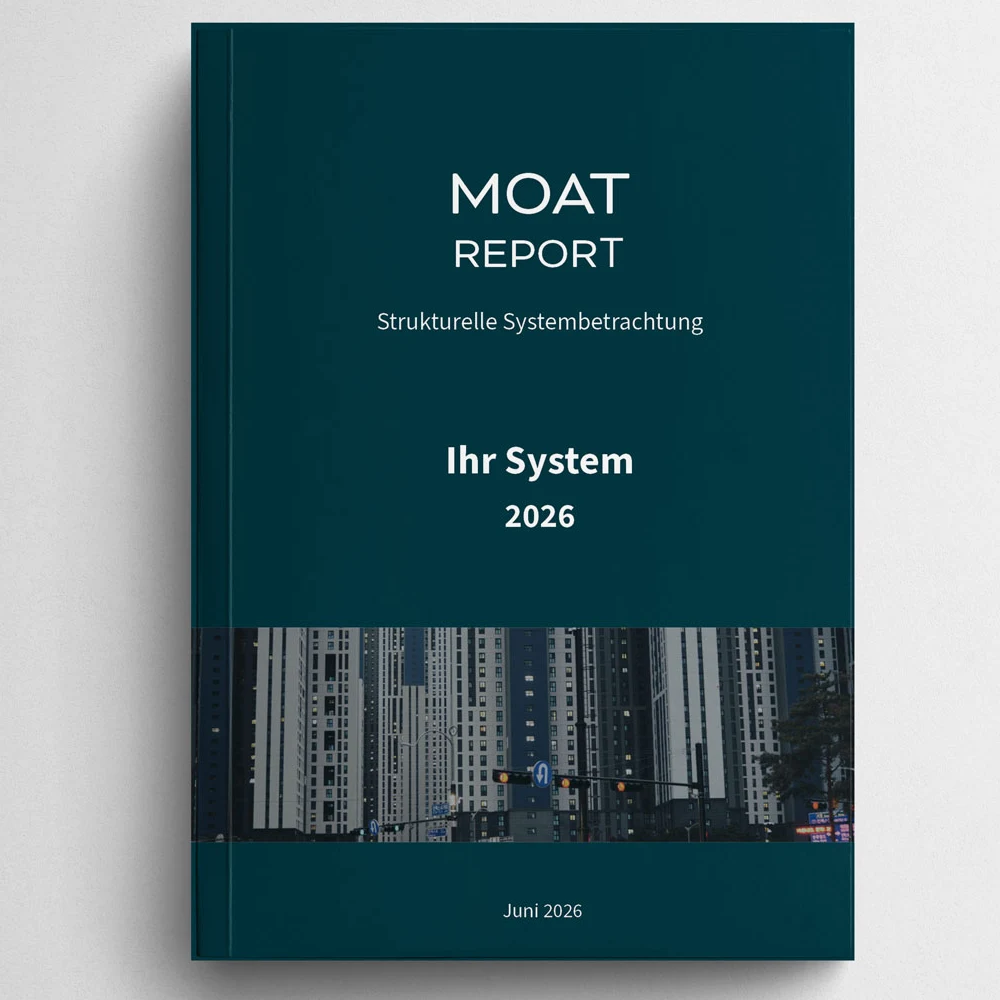
Multiple spaces, complex, scalable. – Reports are as comprehensive as the objectives and the task require.
What is it for?
- 1. Overview
Where the system deviates from the target path. - 2. Insight
Where handover points are bottlenecked or friction arises. - 3. Capacity vs. Process
Where processes are overloaded. - 4. Behaviour
Which routes are used — and which are blocked. - 5. Cascades
Which triggers amplify or disrupt the system. - 6. Development
How the system shifts over time. - 7. Backdrafts
Where technical or organisational risks lie. - 8. Capacities
Where overload or underload occurs. - 9. Axes of conflict
Where lines of interest collide. - 10. Proportionality
How an event affects other areas.
MOAT REPORT
Exactly what you need, in the format you want to use it.
Ad hoc reports on pressing issues are a matter of course. This ranges from decision-making or decision preparation through to the comprehensive mapping and evaluation of businesses and local authorities within various envelopes, incorporating all relevant layers and interdependency analyses.
The report is designed for operational use or as a widely communicable status report with target comparison.
Solutions are not explicitly part of the analysis. Implicitly, it is almost impossible to ignore levers, because MOAT shows where they have an impact.
Presence: Unlike other MOAT-based methods, MOAT requires a (limited) presence over a tailored time period.
LEX – when an area is under pressure

LEX – the tool for processes under pressure
- 1. Effect
What is currently having an effect in the process?
Tasks, dependencies, bottlenecks. - 2. Energy
Where does the load arise?
Pressure points, overload, friction, waiting times, operating times. - 3. Load-bearing capacity
What holds up — and what tips over?
Limits, tipping points, structural weaknesses. - 4. Redundancies & interfaces
Which target paths are designed how.
Dual paths, data loss, handover/communication drift
LEX REPORT
A ‘space’ — all relevant aspects.
Whilst MOAT is a cluster of specifically defined fields of observation that are mapped individually and collectively, LEX is merely an area under pressure. Identifying forces that obstruct, distract, dazzle, counteract and disperse forms the basis for possible, precise interventions in arrangements and processes.
Solutions can be derived, as with MOAT.
Prime locations are losing their appeal. Key tenants are walking away.
Local authorities are taking a stand against traffic.
... and maintenance teams are struggling with BIM and point clouds.
PEC – Properties must deliver

PEC – The tool for objects that need to withstand loads.
- 1. Objective
What is the object intended to achieve?
Function, effect, contribution. - 2. Stability
What keeps the object stable?
Structure, capacity, limits. - 3. Disturbances
Which factors actually influence performance?
Effort, location, structure, condition, usage, market, trends - 4. Tipping points
When and how does the object fail?
Risks, drift, strength and direction of the source
PEC REPORT
A concise yet in-depth profile.
Acquire, alter, hold and alter, prepare and/or push aside.
PEC works with portfolio objectives. The issuer profile sets it apart from standard indicators and expert reports.
Solutions: Issuer control or a strong counter-issuer that nobody had on their ‘radar’ is often sufficient for a revaluation. This is not a ‘creative idea’, but the logical, mechanical consequence within the field of forces.
The drift radar shows where it occurs and in which directions it moves.
The rest is down to control.
DRIFT RADAR – Currents in systems
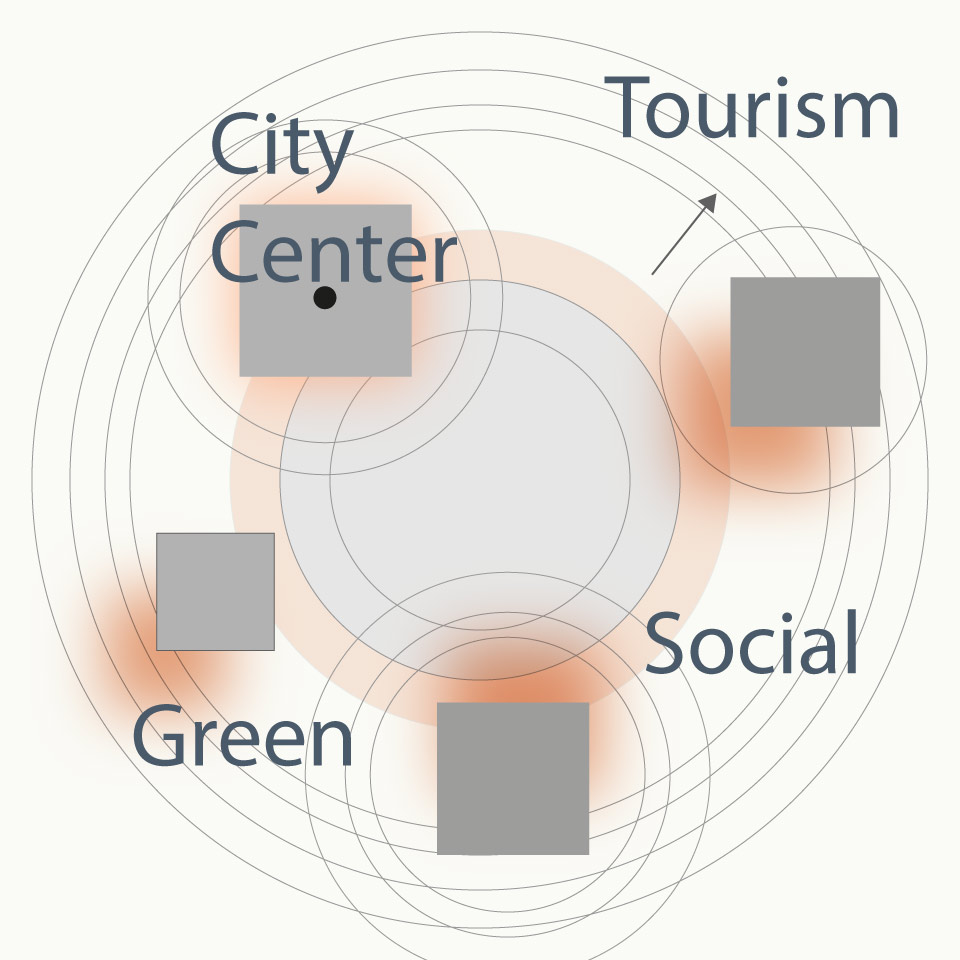
- 1. Behaviour
What people do — in spaces, along paths, at transitions. - 2. Disruptions
What no longer fits the expected behaviour. - 3. Overlaps
What influences one another. - 4. Patterns
What repeats itself — spatially, socially, functionally. - 5. Trends
The direction in which behaviour is developing. - 6. Tipping points
Where drift leads to a breakdown. - 7. Plans & Visions
Where the idea fails in the face of reality. - 8. Regulation
What can be done at an early stage and where the scope and levers for this lie.
DRIFT-RADAR
Drift Radar detects behaviour that is already visible — but is not yet understood as a pattern or a trend, or where attempts to counteract it fail or yield only short-term effects. It identifies disruptions, overlaps and trends arising from spatial, social and functional relationships.
Drift Radar is technically similar to MOAT, but procedurally shifts from a macro-level perspective to a local, lens-based analysis. Long-term behaviour within environments and changes therein are determined on a layer-by-layer basis using emitters and vectors.
Solutions: Drift-Radar has no sub-goals or milestones. The task of Drift-Radar is to locate ideal spaces for action and to determine the nature and strength of emitter control and counter-emitters. It forms the basis for decisions or discursive processes.
Switch – Change of direction
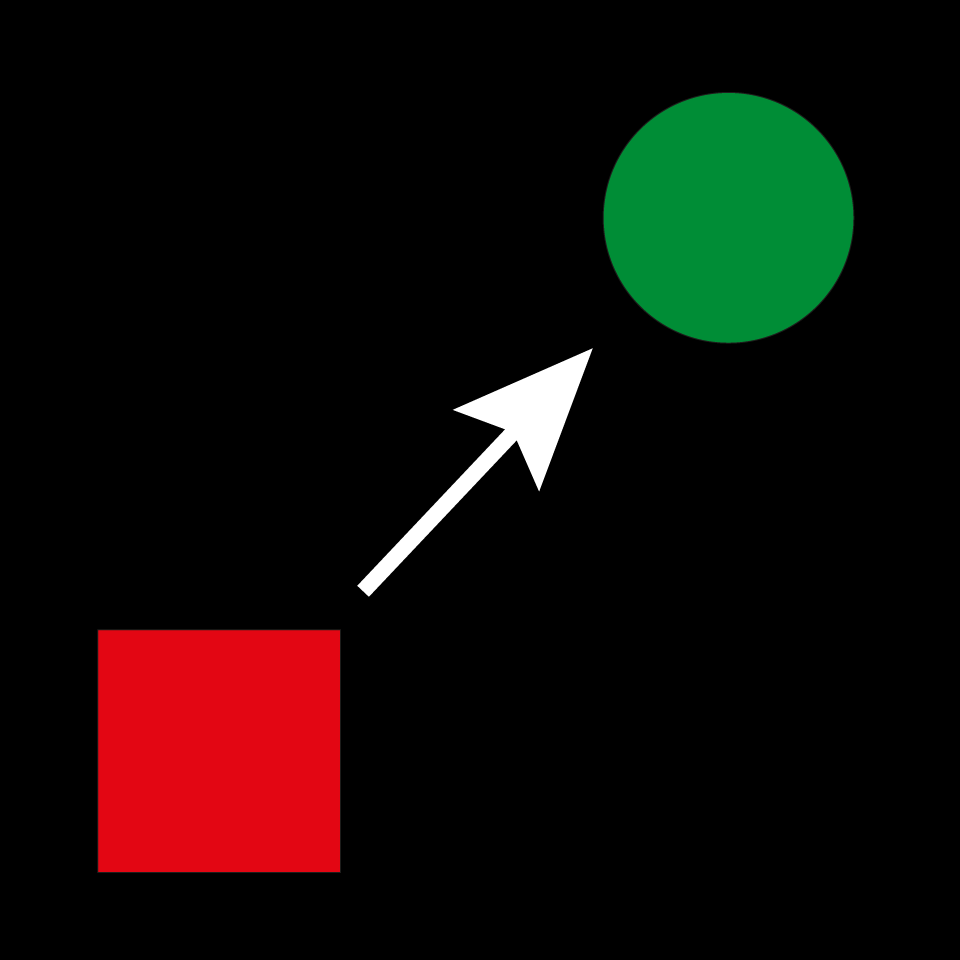
Switch – a change of course based on deductive reasoning.
What for
- 1. Reorient assets
Align machinery, products, premises and residual values with a new objective. - 2. Capitalise on legacy issues
Logically restructure poor decisions, overcapacity and outdated lines rather than writing them off. - 3. Link secondary lines
Connect existing areas in such a way that they reinforce the new main line. - 4. Sharpen the main line
A clear, deductive path to the goal — without distractions. - 5. Activate residual value
Turn underestimated machinery, products or spaces into key building blocks. - 6. End misallocations
Anything that drains energy is neutralised or repurposed. - 7. Reallocate capacities
Redistribute workloads, adjust cycle times, and reschedule operating hours.
The mechanical switch
- 8. Capitalise on market disruption
When the market shifts, existing assets are reoriented towards the new demand. - 9. Generate rapid results
SWITCH is not a process — it is an intervention. Results in weeks, not years.
Planning & change of direction — (partly) operational, not neutral
SWITCH does NOT involve any financial strategy frameworks. It is the tough, atypical reorientation of a company using existing resources. It utilises existing machinery, premises, products and residual values — and realigns strong performers towards a new objective. Without transformation, without restructuring, without asset stripping.
Conditions: There is a willingness and ability to act. Retaining staff and assets is the core objective.
Preparation: MOAT in a rigorous, deductive mode, without sub-goals.
Because dependence is not a concept.
Morph – Dynamic pressure distribution
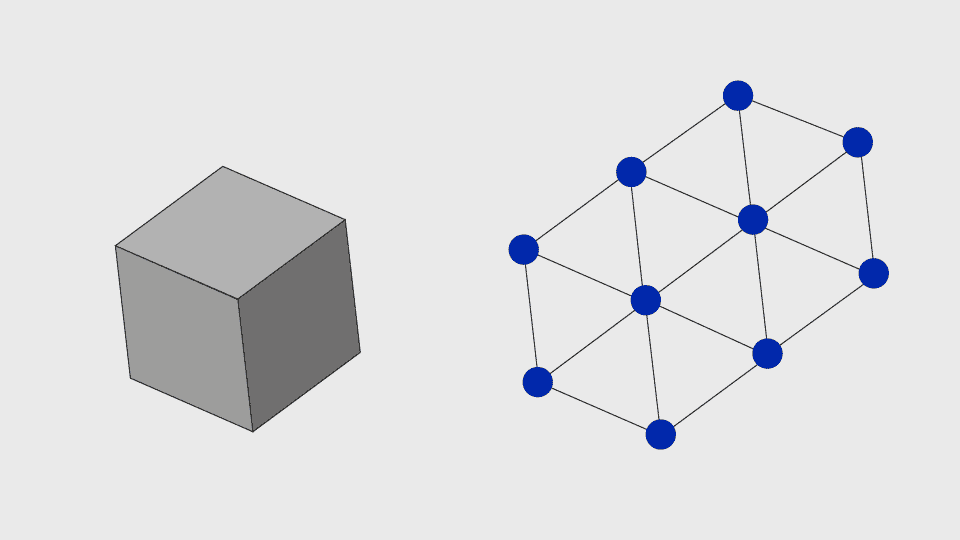
About
- Structural adjustment
Reorganise areas step by step. - Path smoothing
Close drift paths, stabilise secondary paths. - Load stabilisation
Reduce overcapacity, make sensible use of undercapacity. - Synchronisation
Align divisions so that the new direction takes hold. - Preservation of assets
Preserve machinery, spaces and products — do not replace them.
The mixing desk
MORPH gradually realigns structures, streamlines processes, stabilises capacity and redistributes workloads. It utilises existing resources to achieve a new direction — without making drastic cuts.
Background: MOAT
MORPH – The tool for consolidation.
They spring from the substance.
SPACE – Function follows Physics
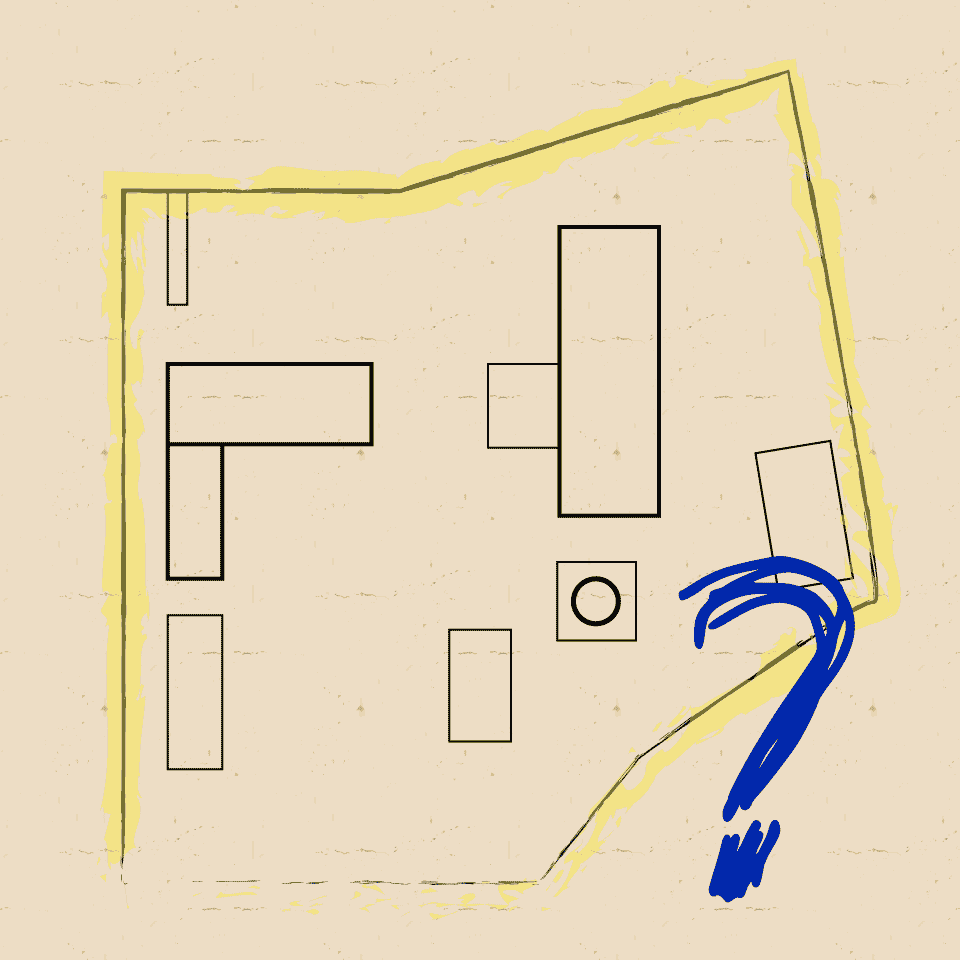
Was
- Change
SPACE begins when a use ends or when a use is planned. - Define objectives
Property objectives, usage objectives, time objectives, process objectives - Location
Micro- and macro-emitters - Existing conditions
Existing elements — structural, technical, spatial. - Use alignment
Check the suitability of the planned use or adapt the new use. - Restructure
Pathways, transitions, volumes and capacities are automatically reordered. - Avoid cost traps
Unnecessary demolition, unnecessary alterations and poor decisions are prevented through deductive reasoning.
Creativity comes later
Usage concepts for properties and existing portfolios — not neutral.
SPACE reduces the drift in the chaos of opinions, which would otherwise be costly to compensate for.
The utilisation concepts are not mere ideas. They are based solely on property-, location- and market-specific factors, as well as the owners’ hard targets.
Background: LEX + PEC
SPACE – The tool for encumbrances
What MOAT is not
MOAT does not evaluate the shooter, but considers all layers.
1 — No coaching
MOAT does not facilitate discussions, gather opinions, run workshops or stick Post-it notes.
There are no ‘team sessions’, no ‘reflection’, no ‘let’s have a chat about it’.
but
- MOAT collects data,
- supplies workshops,
- asks about objectives and communicates during results tracking.
2 — No process chain
MOAT does not draw arrows, swimlanes or step-1-to-7 diagrams.
There is no ‘locate fault — set priority — enter alternative’.
but
- MOAT works with vectors.
- Priorities are results.
- MOAT calibrates envelopes and adjusts spaces.
3 — No team meetings
MOAT requires no meetings, no coordination, no consensus-building.
There is no ‘Let’s compare our fault reports’.
but
- MOAT in its full form participates passively in meetings,
- also delivers interimresults,
- provides an opportunity for discussion.
4 — No change management
MOAT does not implement change processes. It does not build a culture, write visions or facilitate transformation.
There is no ‘journey’, no ‘story’, no ‘we’re taking everyone with us’.
but
MOAT is a preliminary stage and determines the architecture of the change.
It shows where change is necessary, what structure it requires, and what mechanisms would support or hinder it.
5 — No creative phase
MOAT is not looking for ideas, alternatives or ‘What could be better?’ sessions.
There are no brainstorming sessions, no ‘idea parks’.
but
- MOAT provides spaces for public participation and targeted ideas = concepts,
- evaluates ideas and provides topics for discussion.
6 — No role assignments
MOAT does not replace anyone, does not create new departments, does not build teams.
There is no permanent integration of personnel.
but
- MOAT has telemetry functions,
- can provide structure,
- MOAT supplies workshops
- asks about objectives.
7 — No permanent format
MOAT does not stay. MOAT arrives briefly, stabilises and leaves again.
The derived formats usually do not require a physical presence.
but
- MOAT has telemetry components.
- Bandwidth is also useful later on.
- Complexity requires insight.
MOAT – Getting started / Initial contact
You specify the objective, problem or area.
An area, a process, an object, a project or a situation is sufficient.
Email to: moat@krautwedel.com
The method is automatically determined based on your requirements and the existing system.
Based on the objective, scope and problem scenario, it is deduced whether MOAT, LEX, PEC, Drift Radar, SWITCH, MORPH or SPACE is applicable.
The procedures are area-specific and are configured for each individual case.
No toolbox. No alternatives. No plans.
You will receive brief feedback with specific queries.
Each method has its own telemetry: layers, drift fields, emitters, transitions, capacities, object loads. The queries already indicate which method we are using.
Once the scope required to determine the extent and depth (layers) has been defined, you will receive a quote.
The effort involved, duration, field coverage and format of the results are clearly defined. Depending on the method, the alternative report options are specified.
Your benefit:
- A single point of entry.
- No need to choose a method.
- No complexity.
Just objective → scope → method → result.
Following commissioning
Process as per quotation. Depending on the procedure, scope and area, all requirements relating to security and confidentiality are taken into account. Required evidence, approvals and certificates are obtained and complied with.
The task defines the procedure.
The following list of some typical use cases provides an overview of the scope and categorisation.